
Tuesday, September 8, 2026

Most investors are familiar with the 60/40 portfolio concept, where 60% of a portfolio is held in equities and 40% in bonds. It’s been a popular model for some time due to its effectiveness.
The stocks portion of the portfolio serves as the growth engine. The bonds serve as a stable presence, offering steadiness and income. When stocks fall, high-quality bonds often hold steady or rise.
The general idea is the stocks generate the bulk of the returns while the bonds smooth out the ride. And it worked for a long time:
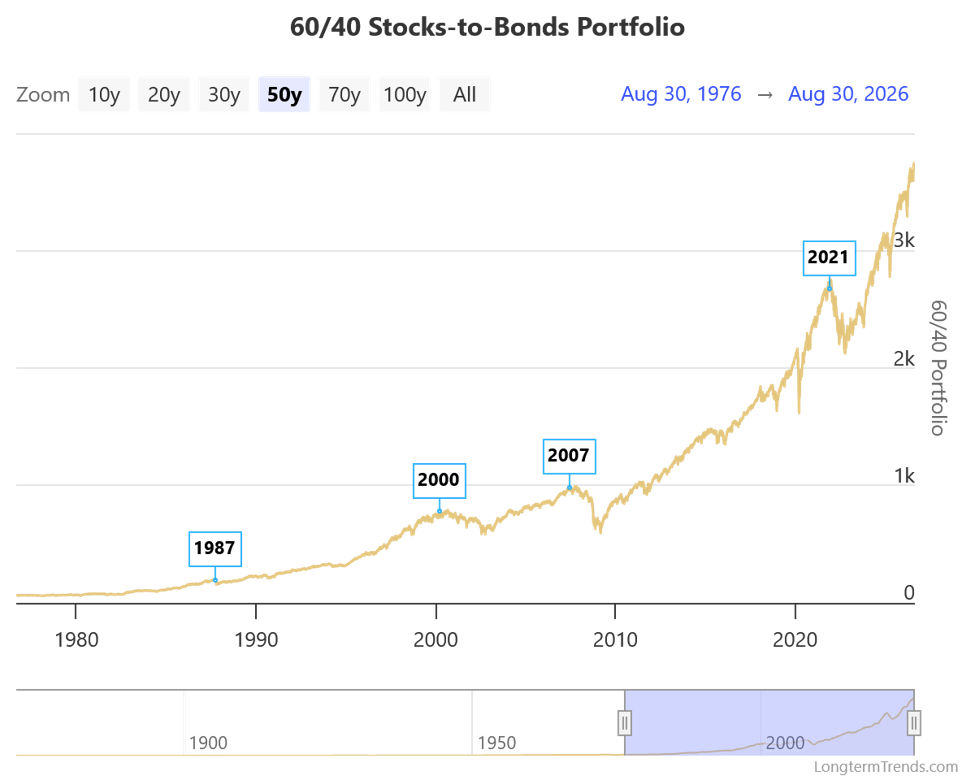
But now the 60/40 portfolio concept seems to be dead.
The correlation between daily moves for the S&P 500 and the 10-year Treasury yield has fallen to its most negative reading since 1999. Generally, rising yields are associated with weaker stock market performance while falling yields support equities. Remember, bond prices move inversely to yield.
So, if higher yields push stocks down, bond prices and stocks are falling together.
Through the decade before COVID, stocks and long-dated Treasurys reliably moved opposite of each other. That’s what made bonds a hedge.
But that critical relationship flipped. Stocks and bonds now move together.
That means the shock absorber in a traditional 60/40 portfolio – the bond side – is gone. It’s because stocks and bonds are now correlated. If one is up, both are up; and if one is down, they both are down.
That makes the 60/40 portfolio behave more like a leveraged portfolio, not a diversified setup that can handle most market conditions.
Daniel A. White is an investment advisory representative of and provides advisory services through CoreCap Advisors, LLC. Daniel A. White & Associates and CoreCap Advisors are separate and unaffiliated entities.