
Monday, March 9, 2026

Inflation is returning to the U.S.
We can thank trade wars and huge government deficits for crushing the bond market. Resulting higher interest rates then crush the stock market, which is worth more than 200% of economic output and trading at multiples that can only exist with miniscule interest rates.
Markets priced for perfection won’t handle the risk of much higher inflation calmly. Instead, we’re at risk of a huge price route for financial assets. It’s being telegraphed, and it’s likely to get worse.
For instance, a basket of silver, copper, zinc, and aluminum – all key industry metals – is up 100% over the past year. These prices haven’t been seen since the 1970s. And history shows these types of producer price increases typically hit consumers 18-24 months later.
Look at Caterpillar, Inc. It’s a great business. But it imports raw materials like steel and aluminum because they aren’t produced domestically.
Taxing imported raw materials doesn’t bring jobs to the U.S. It brings revenue to the government, paid by an American business. President Trump’s bid to massively increase federal government revenue threatens Caterpillar’s ability to build the machines we need.
In 2025, Caterpillar paid $1.7 billion in tariffs. Its 2026 tariff outlook is $2.6 billion. This directly erodes margins and profitability.
Not surprisingly, the stock fell below $300 per share immediately following April tariff announcements. Today, it’s trading over $766 a share and was the Dow Jones Industrial Average’s top stock last year.
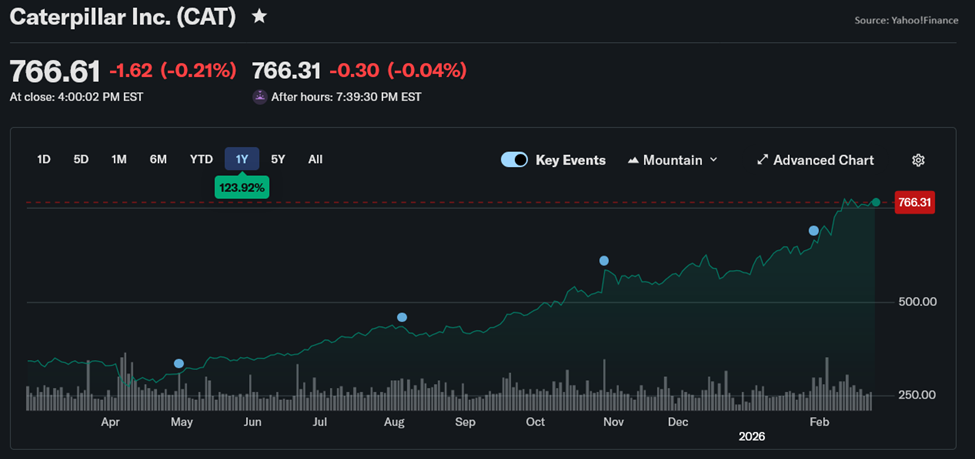
Why is that? The company raised prices significantly (around $1.5 billion in price increases are expected this year).
But remember, consumers pay all production costs. America’s companies will inevitably pass these higher costs on to us.
We don’t need more taxes. We need a government to live within its means.
Daniel A. White is an investment advisory representative of and provides advisory services through CoreCap Advisors, LLC. Daniel A. White & Associates and CoreCap Advisors are separate and unaffiliated entities.